The single most powerful financial decision you can make in your 20s and 30s is to start investing early. Not perfectly. Not with a lot of money. Just start. The reason is compound returns: money invested at 30 has 35 years to compound before a typical retirement at 65. Money invested at 45 has only 20. Starting 15 years earlier roughly doubles the outcome, with the same monthly contribution.
Key takeaways
- £200/month invested from age 25 at 7% grows to ~£525,000 by 65; starting at 35 produces ~£243,000 — less than half, same contribution
- Always prioritise employer pension matching first — it’s an immediate 50–100% return before any investment growth
- Use a Stocks and Shares ISA for medium-term goals and accessible investing; pension for long-term retirement
- For most new investors: a low-cost global equity index fund with an OCF under 0.25% is the right starting point
- The biggest risk at 25–35 is being too cautious — cash loses purchasing power to inflation over the long run
Why Time in the Market Beats Timing the Market
To make the compounding argument concrete: £200/month invested from age 25 at 7% per year (a reasonable long-run assumption for a globally diversified equity portfolio) grows to approximately £525,000 by age 65. The same £200/month starting at age 35 grows to approximately £243,000 — less than half, with the same monthly contribution. The first 10 years of contributions account for a disproportionate share of the final pot.
This means the most important investment decision you will make is not which fund to pick — it is simply to start. A mediocre fund started at 25 will almost certainly outperform an optimal fund started at 35.
The corollary: do not wait until you feel you know enough, or until markets look cheaper, or until you have a larger sum. These are common delaying tactics that have a measurable, often irreversible, cost.
The Four Wrappers: Which Account to Use
UK investors have four main tax-efficient accounts. Choosing the right wrapper matters almost as much as choosing the right investment.
1. Workplace pension
If your employer will match contributions, this is always the priority. Employer matching is an immediate 50–100% return on your money before any investment growth. Pension contributions also attract tax relief (20–45% depending on your tax band), making this the most tax-efficient vehicle available to most people.
2. Stocks and Shares ISA
No income tax or capital gains tax on growth or withdrawals, flexible access at any time, £20,000 annual allowance. The ISA is the natural home for medium-term investments (goals 5–20 years out) and for savings you might want to access before pension age. Use our ISA vs Pension Comparison to compare how each wrapper performs for your income, tax band, and target retirement age.
3. Lifetime ISA (LISA)
For first-time buyers under 40 or retirement saving: £4,000/year with 25% government bonus. The LISA is particularly powerful as a complement to a pension before age 40. See the access rules and property cap in our Lifetime ISA vs Pension guide.
4. General Investment Account (GIA)
No tax wrapper, but useful once your ISA and pension allowances are exhausted. Gains are subject to CGT (at the 18%/24% rates for 2026/27), so you would use the annual CGT exempt amount (£3,000) and basic-rate band allowance to manage tax on withdrawals.
What to Actually Invest In
For most new investors in their 20s and 30s, the answer is simple: a low-cost, globally diversified equity index fund. Examples include:
- A global equity tracker (e.g. a fund tracking the FTSE All-World or MSCI World index)
- A Vanguard LifeStrategy fund (pre-built blend of equities and bonds at your chosen risk level)
- A multi-asset fund from a provider like Fidelity or BlackRock
The key criteria:
- Low ongoing charge (OCF) — Aim for under 0.25% per year. Fund charges compound over decades: a 1% charge on a £100,000 portfolio costs roughly £65,000 more in fees than a 0.15% charge over 30 years.
- Global diversification — A fund that holds thousands of companies across dozens of countries is less exposed to any single economy’s problems than a UK-only fund.
- Equity-heavy at this age — With 30+ years to retirement, you can tolerate short-term volatility in exchange for higher long-run returns. A rough rule of thumb is to hold roughly (100 minus your age) in equities — so 70–80% equities at age 25–30.
How Much Risk Should You Take?
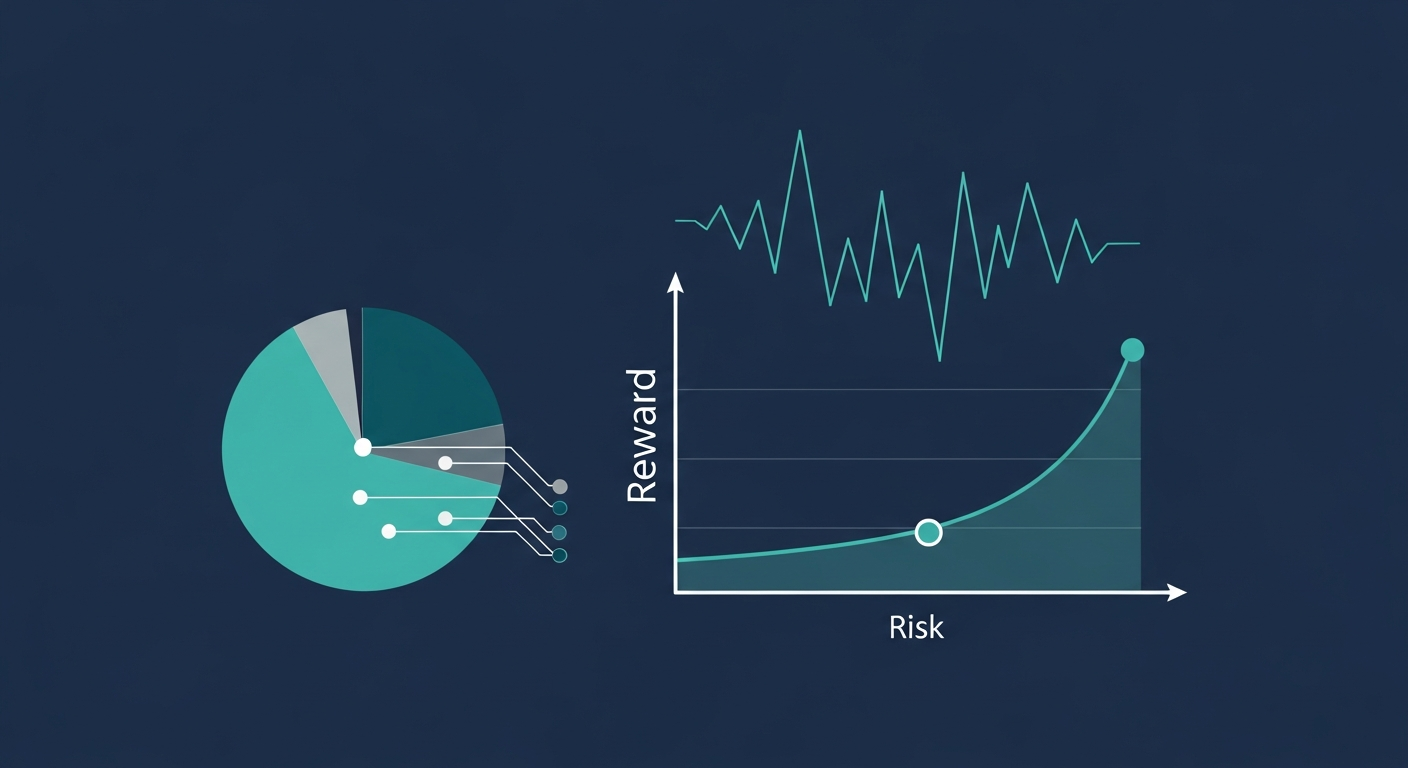
At 25–35 with a 30+ year investment horizon, the biggest risk is not taking enough risk. Keeping everything in cash — currently earning 4–4.5% AER — sounds safe, but inflation at 3% per year erodes roughly 30% of purchasing power over a decade. Real wealth is built by staying invested in productive assets through market downturns.
That said, risk tolerance has a behavioural component as well as a mathematical one. If a 30% market fall would cause you to sell in panic, holding a highly aggressive portfolio will underperform a more moderate one, because you’ll crystallise losses at the worst moment. Be honest about your actual reaction to a falling portfolio, not your theoretical one.
Our financial planning tools include scenario modelling to help you understand how different risk levels affect projected outcomes at your retirement date — and what a bad sequence of returns would mean for your plan.
Three Mistakes That Cost New Investors the Most
1. Waiting for the “right time” to invest
There is no right time. Markets feel expensive when they’re high and scary when they’re falling. Time in the market consistently outperforms timing the market. If you have a lump sum, the data suggests investing it immediately in most cases rather than drip-feeding (though regular monthly investing eliminates the decision entirely).
2. Paying high fund charges
A 1.5% annual fund charge on a 30-year investment can consume 30–35% of your final pot compared to a 0.2% charge on the same underlying assets. This is the most important number most new investors never check. Always verify the OCF (ongoing charges figure) of any fund you hold.
3. Checking the portfolio too often
Short-term market volatility is noise. Investors who check their portfolios daily are more likely to make emotional decisions — selling after falls or chasing winners — that consistently underperform buy-and-hold. Set your monthly contributions, automate them, and review quarterly at most.
If you want tailored guidance on your investment strategy, asset allocation, and tax wrapper choices, a regulated financial adviser can provide a personalised recommendation based on your full financial picture.
Important: This article is for general educational purposes only and does not constitute financial advice. Tax rules can change and individual circumstances vary. If you need advice tailored to your situation, please consult a qualified, FCA-regulated financial adviser. You can browse advisers in our adviser directory.