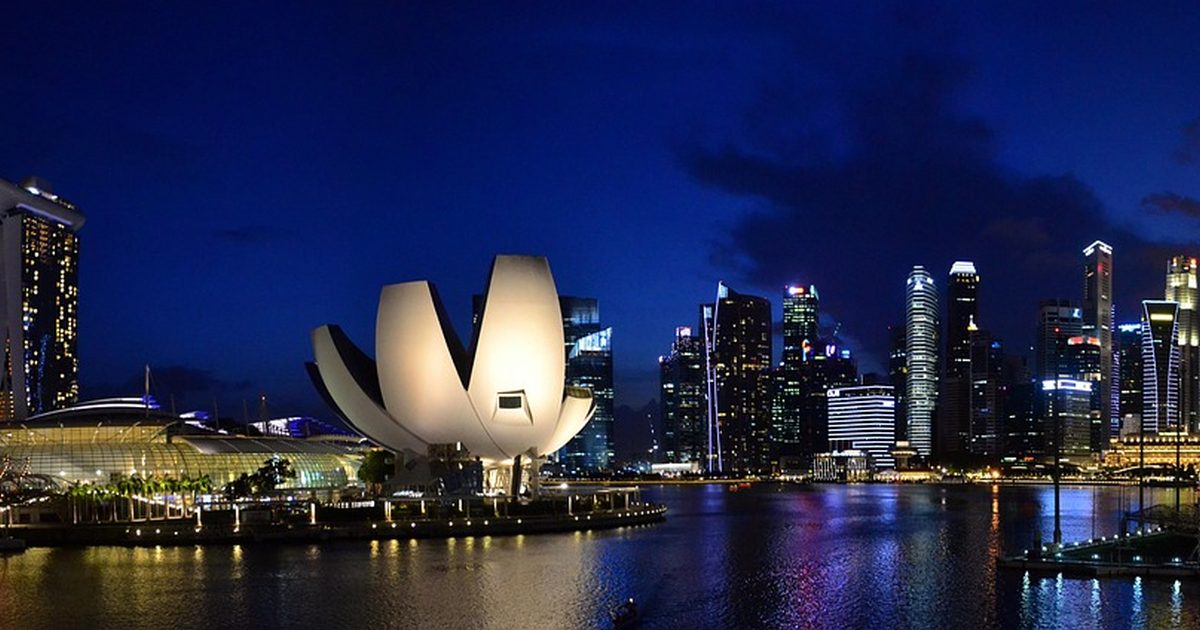
Singapore is one of the world’s great business cities — a financial, technology, and trading hub connecting South-East Asia with global markets. Around 65,000 UK nationals live there, drawn by a well-regulated, English-speaking environment, low-to-moderate personal income tax, strong rule of law, excellent healthcare and infrastructure, and a very high quality of life. Singapore operates an Employment Pass (EP) system for professional-level roles, with minimum salary thresholds. International school fees are among the highest in Asia, and the overall cost of living is very high — but high compensation packages across finance, technology, law, and professional services mean that net financial outcomes are strong for qualifying professionals.
Key takeaways
- Employment Pass (EP) requires a minimum SGD 5,600/month salary (SGD 6,200 in financial services) and passing the COMPASS points framework
- No UK–Singapore social security agreement: pay voluntary Class 3 NI (£907/year in 2026/27) to protect your UK State Pension
- A medium lifestyle for a family of 4 costs around £11,300/month (£135,600/year) — illustrative, June 2026; finance and law packages often include school-fee allowances
- International school fees: SGD 30,000–60,000/year per child (£17,200–£34,300); Dependant Pass requires EP holder earning SGD 6,000+/month
- Singapore personal income tax is 0–22% progressive; effective rate typically 13–16% for senior professionals; no CGT or inheritance tax
- This is general information, not personal financial, tax, immigration or legal advice
Work & income: what UK professionals earn
Singapore has a progressive personal income tax system with rates of 0–22% (effective rate for most professionals in the 15–18% range once personal reliefs are applied). The top statutory rate of 24% applies only on chargeable income above SGD 1,000,000. For a professional earning SGD 200,000 (£115,000) gross, the effective income tax rate is approximately 13–16% — substantially lower than the UK equivalent. There is no CGT on personal investments and no inheritance tax in Singapore.
Typical gross annual salaries for UK professionals in Singapore in 2026: SGD 100,000–250,000 (£57,000–143,000) for senior roles in banking, technology, law, and professional services; SGD 250,000–500,000+ (£143,000–286,000+) for managing director, partner, and C-suite levels. Use our financial planning tools to model your Singapore net income, voluntary UK NI contributions, and long-term financial plan. A regulated financial adviser with Singapore–UK cross-border expertise is strongly recommended: UK residency rules, the treatment of UK-sourced income, CPF obligations for PR holders, and pension strategy are all areas requiring specialist input.
The money: a 3-tier monthly family budget
The table below is an itemised monthly budget for a family of four (two adults, two school-age children) in Singapore. All figures in GBP at illustrative June 2026 exchange rates (SGD 1 ≈ £0.572). International school fees are the largest single cost variable; most expat packages in finance and law include a school-fee allowance. The Medium column — approximately £11,296 a month (£135,600/year) — reflects a comfortable lifestyle in an expat-popular district (Bukit Timah, Holland Village, Dempsey) with one child at an international school.
| Monthly cost (family of 4) | Basic | Medium | High |
|---|---|---|---|
| Rent (3-bed condo/apt) | £2,800 | £4,200 | £7,000 |
| Utilities & internet | £200 | £290 | £420 |
| Groceries | £600 | £900 | £1,400 |
| Transport (car & MRT) | £400 | £650 | £1,100 |
| Healthcare (employer plan + top-up) | £200 | £350 | £600 |
| School fees – 2 children (term 1/12) | £2,000 | £3,200 | £5,300 |
| Eating out & leisure | £500 | £800 | £1,500 |
| Household help (helper) | £300 | £400 | £500 |
| Clothing, personal, sundry | £250 | £430 | £750 |
| Voluntary UK NI (Class 3) | £76 | £76 | £76 |
| Monthly total (approx) | £7,326 | £11,296 | £18,646 |
Illustrative monthly estimates for a family of four in Singapore, June 2026. School fees annualised and divided by 12; charged termly. Finance and law packages often include housing and school-fee allowances. Exchange rate: SGD 1 ≈ £0.572. Car ownership in Singapore is very expensive (COE premiums); many families use a combination of taxis/ride-hailing and MRT.
Annual equivalents: Basic ≈ £87,900/year — Medium ≈ £135,600/year — High ≈ £223,800/year.
Visas & residency: the Employment Pass
UK nationals wishing to work professionally in Singapore require an Employment Pass (EP), issued by the Ministry of Manpower (MOM). Key requirements in 2026:
- Minimum fixed monthly salary: SGD 5,600 (from January 2025; SGD 6,200 for the financial services sector). Candidates must also meet a “points-based Complementarity Assessment Framework (COMPASS)” test covering salary benchmarking, qualifications, diversity, and employer track record. High-scoring candidates receive the EP faster.
- The EP is employer-sponsored: your Singapore employer applies to MOM on your behalf before you start work. Valid for two years initially; renewable as long as employment continues.
Dependant sponsorship: EP holders earning SGD 6,000+/month can apply for a Dependant Pass (DP) for a spouse and unmarried children under 21. EP holders earning SGD 12,000+/month can additionally apply for a Long-Term Visit Pass (LTVP) for parents. For EP holders below SGD 6,000, dependant passes are not automatically available — a key consideration for families. Singapore Permanent Residency (PR) can be applied for after approximately two years on an EP; it is not guaranteed but is granted to a substantial proportion of applicants with strong employment records.
Schools & education
Singapore’s government schools are of an exceptionally high academic standard; Singapore consistently ranks at or near the top of international PISA rankings. However, local state schools are highly competitive, teach the Singapore curriculum (not GCSE/A Level), and have limited places for non-residents. Most UK expat families use international schools.
Singapore has some of the most expensive international schools in the world. Leading schools with a British-curriculum or IB flavour include Tanglin Trust School, United World College South East Asia (UWCSEA), the British Council Singapore, Chatsworth International School, and Anglo-Chinese School (International). Annual fees in 2026 range from approximately SGD 30,000 to SGD 60,000 per child per year (£17,200–£34,300), with the most prestigious schools at the top of this range. Most senior expat packages in finance and law include a school-fee allowance of SGD 25,000–50,000 per child; confirm what is included before comparing packages. Figures are illustrative and sourced as of June 2026.
Childcare
Singapore has a subsidised childcare framework for Singapore citizens and Permanent Residents (the Child Care Subsidy Scheme), but EP holder families generally do not qualify for the largest subsidies. Full-day childcare centre fees in Singapore for EP holders run approximately SGD 2,000–4,500/month (£1,140–2,575) per child before any subsidy; top-tier international pre-schools can be higher. A Foreign Domestic Worker (FDW) (live-in helper) is very commonly used in Singapore; the foreign domestic worker levy is SGD 300/month for most households, and salaries are typically SGD 700–1,100/month (£400–630), making live-in childcare support more affordable than in the UK. Figures are illustrative and sourced as of June 2026.
Healthcare
Singapore has an excellent healthcare system, consistently ranked among the top globally. The system combines a public sector (polyclinics for primary care; restructured hospitals like SGH, NUH, TTSH for secondary/tertiary) and a large private sector. Costs in the public sector are subsidised for Singapore citizens and PRs; EP holders pay unsubsidised rates but these are still generally lower than equivalent private-sector costs in the UK or USA. Most employers provide comprehensive private health insurance as a standard benefit for EP holders and their Dependant Pass holders — confirm this with your employer. Singapore citizens and PRs are covered by MediShield Life (mandatory basic insurance); EP holders are not enrolled in MediShield Life but should have equivalent employer-provided cover.
Dental care is widely available, high quality, and costs less than equivalent private dental care in the UK. Medical evacuation cover is worth considering for complex treatments, though Singapore’s tertiary care is itself of a very high standard.
Money, tax & UK NI: the critical points
Singapore’s personal income tax is progressive: 0–22% on chargeable income (0% up to SGD 20,000; 2% on SGD 20,001–30,000; rising to 22% on SGD 320,001–500,000). The effective rate for a professional on SGD 200,000 is approximately 13–16% after standard reliefs. There is no CGT, no inheritance tax, and no wealth tax in Singapore. These headline rates make Singapore significantly more tax-efficient than the UK for high earners.
Singapore operates a Central Provident Fund (CPF), a mandatory savings scheme. CPF applies to Singapore citizens and PRs; EP holders are not required to contribute to CPF. This means there is no mandatory “pension-equivalent” deduction from your salary as an EP holder, which is financially advantageous in the short term but means you must take responsibility for your own retirement saving.
There is no reciprocal social security agreement between the UK and Singapore. Working in Singapore does not build UK NI qualifying years. Each year without voluntary UK NI costs approximately £350/year off your UK State Pension for life. Paying voluntary Class 3 NI contributions (£17.45/week, £907/year in 2026/27) is the straightforward fix. Use our projection tools to model your Singapore tax position, State Pension impact, and retirement projections together. Take advice from a regulated financial adviser with UK–Singapore cross-border expertise: the interaction between UK and Singapore tax residency, UK rental income, ISA strategy, and SIPP contributions for UK pensions while Singapore-resident all benefit from specialist input.
Daily life, safety & crime
Singapore is one of the safest cities in the world. It consistently ranks in the top five globally on crime and personal safety indices (GPI 2024). The legal system maintains strict order: littering, jaywalking, and drug possession carry significant penalties; chewing gum sale is restricted; vandalism is a serious offence. In practice, these rules create a very clean, orderly, and safe environment that families consistently cite as a major quality-of-life advantage. Singapore is cosmopolitan, English-speaking, and diverse. The food scene — from hawker centres to Michelin-starred restaurants — is exceptional. The climate is equatorial: warm and humid year-round (28–33°C), with no winter. Crime and safety figures are illustrative and sourced from GPI 2024 and Singapore Police Force Annual Statistics Report 2025.
Family SWOT: working in Singapore
A strengths / weaknesses / opportunities / threats view of a UK working family relocating to Singapore:
Strengths
- Low-to-moderate personal income tax (effective 13–16% for senior professionals); no CGT or inheritance tax
- English-speaking; common law system; excellent rule of law and business environment
- World-class healthcare system; excellent infrastructure and connectivity
- Very safe family environment; very low crime
- No CPF obligation for EP holders — full salary is available for personal allocation
Weaknesses
- No UK–Singapore SS agreement: voluntary NI is essential to protect UK State Pension
- International school fees among the highest in Asia (SGD 30,000–60,000/year per child)
- Dependant Pass requires EP holder to earn SGD 6,000+/month; not available at lower salary thresholds
- Car ownership is very expensive due to COE premiums; transport costs are high for families with cars
Opportunities
- Singapore PR is achievable after 2+ years on an EP and provides long-term stability independent of a single employer
- Excellent gateway for regional Asia-Pacific and ASEAN career development
- UK ISA allowance continues to accumulate regardless of Singapore residency
- Strong UHNW advisory, asset management, and technology ecosystem for senior professionals
Threats
- COMPASS points framework for EP renewals means EP status can be challenged if role benchmarks change
- High overall cost of living — particularly housing and schooling — compresses net savings if package is below market
- UK-sourced income (UK rental property, dividends) remains taxable in the UK regardless of Singapore residency
- Singapore’s geopolitical environment in the broader South-East Asia region introduces longer-term uncertainty
Comparing destinations? See where Singapore ranks in our round-up of the lowest-tax destinations for UK workers abroad, or read the full Working Abroad from the UK guide for all twenty destinations compared side-by-side.
Important: This guide is for general educational purposes only and does not constitute financial advice. Tax rules can change and individual circumstances vary. If you need advice tailored to your situation, please consult a qualified, FCA-regulated financial adviser. You can browse advisers in our adviser directory.