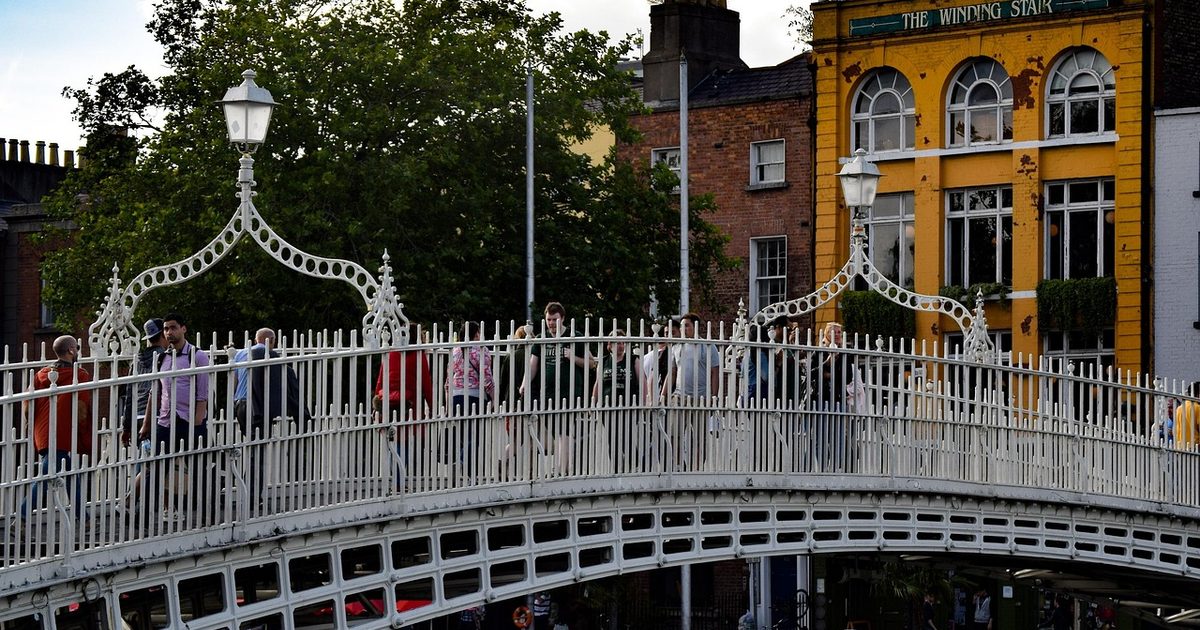
Ireland is the easiest international move available to a UK family — no visa, no immigration application, no points test. The <strong>Common Travel Area (CTA)</strong> means UK citizens can live, work, and access public services in Ireland with the same rights as Irish citizens. Add in an English-speaking society, a shared cultural heritage, and the Eurozone, and it is no surprise that Ireland is consistently in the top five destinations for British families moving abroad.
Key takeaways
- No visa required — the Common Travel Area gives UK citizens the right to live and work in Ireland without any immigration application
- UK State Pension is uprated in Ireland — it is in the EEA, so it rises each year under the triple lock
- A medium lifestyle for a family of 4 costs around £5,810/month (£69,700/year) — illustrative, June 2026; Dublin is at the upper end
- Free state schooling and two years of free pre-school (ECCE) apply from day one of Irish residency
- High earners should note that combined Irish income tax, USC, and PRSI rates reach 40%+ above €42,000
- This is general information, not personal financial, tax, immigration or legal advice
Work & income: what UK professionals earn
Ireland has one of the strongest labour markets in the EU, driven by a large multinational technology, pharmaceutical, and financial services sector concentrated in Dublin, Cork, and Limerick. Average earnings are broadly comparable with the UK; in tech, finance, and pharma the premium over UK salaries is significant.
Irish income tax is charged at two rates: 20% on the standard rate band (up to €42,000 for a single person; higher for couples) and 40% above that. The Universal Social Charge (USC) adds 0.5–8% on income over €13,000. PRSI (Pay Related Social Insurance) is 4% for employees. The combined effective rate for a professional on €80,000 is around 40–44%.
Ireland operates a PRSI-based social insurance system that coordinates with UK NI through the UK–Ireland reciprocal agreement. This is important for preserving your entitlement to both the UK State Pension and the Irish State Pension. Use our financial planning tools to model the interaction between your UK NI record, Irish PRSI contributions, and projected pension income.
The money: a 3-tier monthly family budget
Here is an itemised monthly budget for a family of four (2 adults, 2 school-age children). All figures are in GBP at illustrative June 2026 exchange rates (€1 ≈ £0.85).
| Monthly cost (family of 4) | Basic | Medium | High |
|---|---|---|---|
| Rent (3-bed house/apt) | £1,800 | £2,500 | £4,000 |
| Utilities & internet | £180 | £250 | £340 |
| Groceries | £550 | £730 | £1,050 |
| Healthcare / insurance | £60 | £120 | £250 |
| Transport (1 car or public) | £280 | £430 | £700 |
| Childcare / school costs | £300 | £600 | £2,000 |
| Eating out & leisure | £280 | £520 | £1,050 |
| Clothing & household | £160 | £260 | £430 |
| Savings & misc | £250 | £400 | £750 |
| Monthly total | £3,860 | £5,810 | £10,570 |
| Annual total | £46,300 | £69,700 | £126,800 |
Figures are illustrative, June 2026. Dublin is at the top of these ranges — rent in particular is high relative to incomes. Cork and Galway are typically 20–30% cheaper; rural Ireland cheaper still.
No visa needed: the Common Travel Area
The Common Travel Area (CTA) between the UK and Ireland predates both countries’ EU memberships. Brexit did not affect it. UK citizens have the right to:
- Live and work in Ireland without a visa or immigration application
- Access Irish public services, including public healthcare and education, on the same basis as Irish citizens
- Vote in Irish local and national elections
- Travel freely between the UK and Ireland without passport control
Your employer does not need to obtain a work permit for you. Your family (spouse/partner, children) arrive the same way — no immigration paperwork required. This makes Ireland uniquely accessible and significantly reduces the financial and administrative cost of a move compared with any other international destination.
Schools & education
State primary and secondary schooling in Ireland is free for all children, including UK nationals. The Irish school year runs from September to June. Primary school covers ages 4–12; secondary school (junior certificate at 15, leaving certificate at 17–18) is the university entrance qualification. Irish leaving certificate results are accepted by UK universities, and the move is generally seamless mid-school for children transitioning at primary age.
Private (fee-paying) secondary schools charge €3,000–8,000/year per child (£2,550–6,800) — significantly cheaper than UK independent schools. Third-level (university) fees for Irish residents are heavily subsidised: a student contribution of €3,000/year applies, well below UK tuition fees.
Childcare
Ireland has invested heavily in childcare in recent years. The National Childcare Scheme (NCS) provides income-related subsidies for children from 24 weeks to 15 years. The Free Pre-School Year (ECCE) provides two years of free preschool (about 15 hours/week) for children aged 2 years and 8 months to 5 years and 6 months. UK national families are eligible for these schemes from day one of Irish residency.
Full-day private crèche costs €1,000–1,500/month per child in Dublin (£850–1,275) before NCS subsidy. Outside Dublin, costs are typically €700–1,100/month. This remains expensive but subsidies can reduce net costs meaningfully.
Healthcare
UK nationals in Ireland have immediate access to Irish public healthcare (the HSE — Health Service Executive) on the same basis as Irish citizens under the CTA. GP visits carry a modest charge (€50–80 per visit); hospital treatment is generally free or low-cost. The Medical Card (income-tested) provides free GP visits and reduced prescription costs; many working families do not qualify but can apply.
Private health insurance is widely taken out by working families in Ireland to bypass public hospital waiting lists (private hospitals offer same-week consultant appointments). VHI, Irish Life Health, and Laya Healthcare offer family plans from around €150–350/month (£128–298). Once resident for more than 13 weeks you can join without waiting periods.
Money, tax & NI totalisation
The UK–Ireland reciprocal social security agreement coordinates NI contributions and Irish PRSI so you do not pay into both systems for the same period. While you are working in Ireland and paying PRSI, you build Irish pension entitlement but not UK NI qualifying years.
Because Ireland is in the EEA, your UK State Pension is uprated each year under the triple lock — it is not frozen. This is an important difference from Australia, Canada, and New Zealand, and a key financial advantage of Ireland as a destination.
To continue building UK NI qualifying years alongside Irish PRSI, you can pay voluntary Class 2 or Class 3 NI contributions — though under the bilateral agreement this needs careful checking to avoid inadvertent double qualification rather than double contribution. Currency is a factor: your income is in euros, so any UK assets or savings move in value as sterling/euro rates shift. Our projection tools let you model the dual pension, NI record, and currency impact side by side. Consult a regulated financial adviser with Irish and UK cross-border experience.
Daily life, safety & crime
Ireland is one of the safest countries in Europe — ranked 12th in the Global Peace Index 2024. Violent crime is rare; Dublin has a higher incidence of property crime than smaller Irish cities but remains safe by European standards. The climate is mild, wet, and overcast — similar to the UK, and not a hardship for British families. The cultural adjustment is minimal: English language throughout, similar pub culture, sport, and social norms. The proximity to the UK — a 1–2 hour flight from most UK cities — keeps family visits easy and affordable.
Family SWOT: working in Ireland
A strengths / weaknesses / opportunities / threats view of a UK working family relocating to Ireland:
Strengths
- No visa, no immigration application — Common Travel Area
- UK State Pension stays uprated (EEA agreement)
- Free state schooling; two years of free pre-school (ECCE)
- Access to HSE public healthcare from day one
Weaknesses
- Dublin rents among the highest in Europe relative to local salaries
- Combined income tax and USC/PRSI rates are high (40%+ above €42,000)
- Crèche costs remain high in Dublin before NCS subsidy
- Wet climate and limited sunshine — similar to the UK
Opportunities
- Large tech, pharma, and finance sector — salary premium over UK in many roles
- Eurozone membership: GBP/EUR swings can work in your favour
- Short flights mean UK family visits are cheap and easy
Threats
- Sterling/euro swings reduce the value of UK savings and pension in euro terms
- UK IHT exposure based on long-term UK domicile
- PRSI years do not build UK NI qualifying years — may need voluntary contributions
This guide is general information, not personal financial, tax, immigration or legal advice. Every figure is illustrative and approximate, sourced as of June 2026 — rules and costs change. Take regulated advice before you act.
Comparing destinations? See where Ireland ranks in our round-up of the easiest work visas for UK citizens after Brexit, or read the full Working Abroad from the UK guide for all twenty destinations compared side-by-side.
Important: This guide is for general educational purposes only and does not constitute financial advice. Tax rules can change and individual circumstances vary. If you need advice tailored to your situation, please consult a qualified, FCA-regulated financial adviser. You can browse advisers in our adviser directory.