We spend decades preparing financially for retirement — calculating pension pots, modelling drawdown rates, and working out whether the numbers add up. But very little attention goes to the other side of the transition: what it actually feels like to stop working, and how to thrive in a life where the alarm clock no longer dictates your day. For many people, the first months of retirement are unexpectedly difficult. The structure is gone. The colleagues are gone. The sense of purpose that work quietly provided — even when the work itself was frustrating — is suddenly absent. Fortunately, philosophers, writers, and thinkers have wrestled with exactly this question for centuries. Tom Hodgkinson, author and founder of <em>The Idler</em> magazine, has made a compelling case that the art of leisure is not laziness but a skill — one our culture has largely forgotten how to practise. His ideas, rooted in Aristotle, the Taoists, and his own lived experience, offer a surprisingly practical guide to the psychological adjustment of retirement.
Key takeaways
- The hardest part of retirement is often not financial but psychological — the loss of identity, structure, and social connection that work quietly provided
- Tom Hodgkinson’s philosophy of idleness recasts leisure as a skill and a virtue, not a failure of productivity
- Aristotle’s concept of eudaimonia (“human flourishing”) places leisure at the centre of the good life — work exists for the sake of it, not the other way around
- The Taoist idea of wu wei — going with the natural flow — is a practical guide to building retirement rhythms that are responsive rather than driven
- Active-retirement spending tends to be highest in the “go-go” years (60–75); planning for a front-loaded spend pattern is both realistic and liberating
- Thriving in retirement consistently comes down to three things: purpose, chosen structure, and maintained social connection
The Identity Problem Nobody Mentions
Ask most people what they do, and they will tell you their job. In British culture especially, work is deeply entwined with identity. We introduce ourselves by profession. We measure our worth by productivity. We structure our weeks, friendships, and even our self-esteem around our careers.
Retirement strips all of this away at once. Overnight, the answer to “what do you do?” becomes uncertain. The social rituals of office life — the Monday morning debrief, the shared frustrations over the photocopier, the Friday afternoon drink — disappear. The phone stops ringing quite so urgently.
Research consistently shows that this identity shift is one of the most challenging aspects of retirement. A study by the Institute of Economic Affairs found that retirement increased the probability of suffering from clinical depression by 40% and physical conditions by 60% in the short term. The financial preparation that most people focus on turns out to be only half the work.
The good news is that this is a well-understood transition, and those who navigate it well tend to share a common quality: they have thought deliberately about what they are retiring to, not just what they are retiring from.
Tom Hodgkinson and the Radical Act of Being Idle
Tom Hodgkinson has spent his career making the case that idleness — real leisure, unstructured time, the freedom to do nothing in particular — is not a vice but a virtue. In his talk How to Be Idle (for The Idler, see the Video section below), he traces a simple argument: for decades, the answer to every problem has been “work harder.” Feeling stressed? Work more productively. Feeling unfulfilled? Find a more meaningful job. Feeling tired? Power through.
This mindset, Hodgkinson argues, is not natural — it is a relatively recent cultural imposition. For most of human history, leisure was considered the highest form of life. Work was a necessity, not a virtue. The wealthy did not boast about how busy they were; they cultivated the arts, philosophy, friendship, and pleasure.
The transition into retirement is, in Hodgkinson’s terms, an opportunity to reclaim this older, more humane relationship with time. But because we have been so thoroughly trained to equate busyness with worth, simply stopping can feel profoundly uncomfortable — even when we have the financial means to do so.
The first adjustment, then, is conceptual: learning to see leisure not as idleness in the pejorative sense, but as the genuine work of living well.
Eudaimonia: Aristotle on the Good Life
One of the ideas Hodgkinson draws on most directly is the ancient Greek concept of eudaimonia — often translated as “happiness,” but more accurately rendered as “human flourishing” or, as Hodgkinson puts it, “being at one with your demon.” The daimon in Greek thought was your inner spirit, your essential self. Eudaimonia meant living in full alignment with that self — not pleasure-seeking or achievement-collecting, but authentic being.
For Aristotle, this was explicitly the goal of the good life. And crucially, he argued that eudaimonia required leisure (what the Greeks called scholē, from which we get the word “school”). Not rest from labour, but the free activity of the mind and soul: music, philosophy, friendship, contemplation, civic life.
Aristotle was clear that work was for the sake of leisure — not the other way around. We work so that we can have the time and resources to live well. Seen through this lens, retirement is not the end of purpose but its fullest possible expression: the moment when you finally have the time to pursue the things that matter most to you, unconstrained by the demands of an employer.
The practical implication is significant. Rather than asking “what will I do all day?” in a spirit of anxiety, Aristotle would reframe the question: “Now that you have time, what is your daimon asking of you?”
The Taoist Art of Going With the Flow
Alongside the Greek tradition, Hodgkinson draws on Taoist philosophy, particularly the concept of wu wei — often translated as “non-action” or “going with the flow.” For the Taoists, the ideal life was one lived in harmony with the natural rhythms of the world: sleeping when tired, eating when hungry, working when energised, resting when not. The problem with modern working life is that it imposes artificial rhythms — meetings at 9am regardless of your natural energy, productivity targets regardless of the season, emails regardless of whether you have anything useful to say.
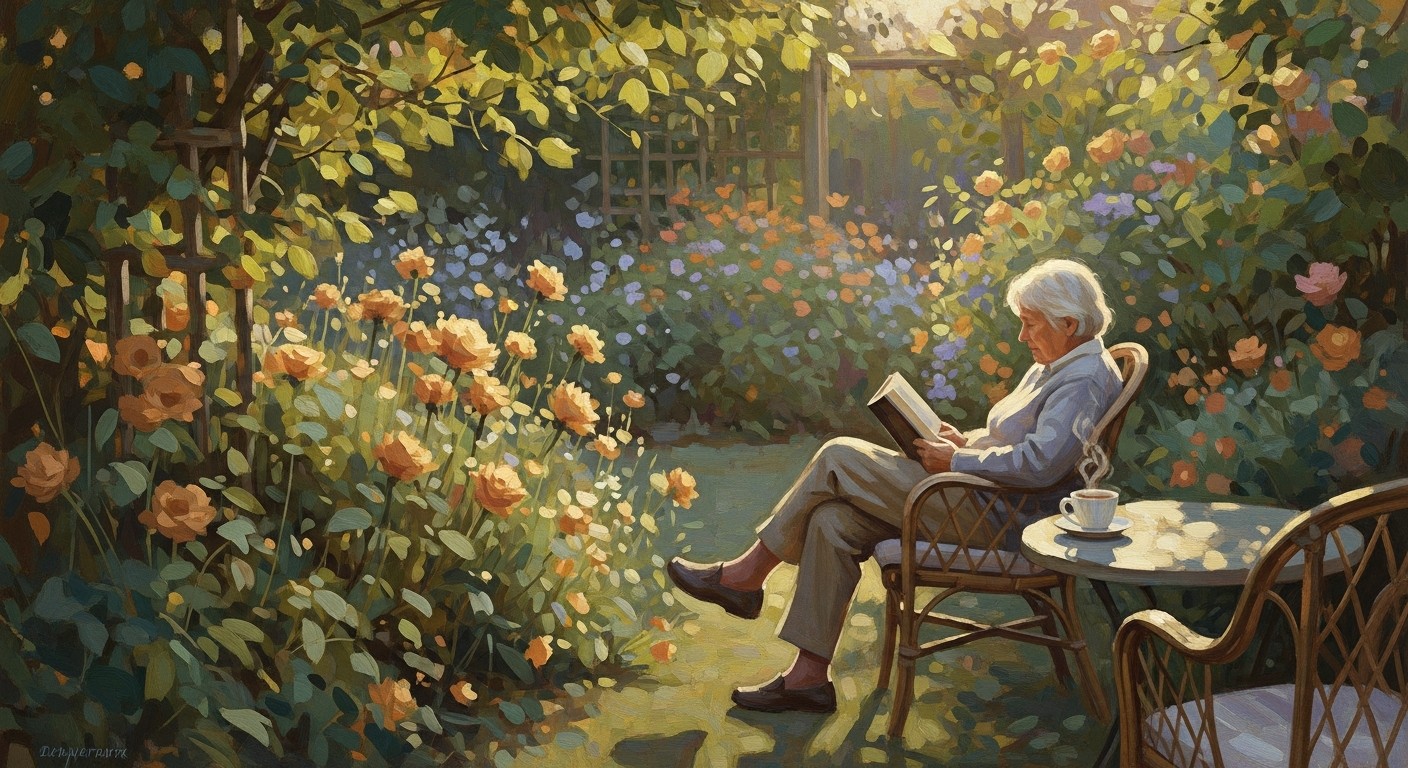
Retirement offers, for many people, the first real opportunity since childhood to live according to natural rhythms. To wake without an alarm. To eat lunch because you are hungry rather than because the clock says noon. To spend a rainy afternoon reading and a sunny one gardening without needing to justify either choice.
The Taoist approach also implies living closer to nature — walks, gardens, the rhythms of the seasons — as a source of grounding and pleasure. Many people who thrive in retirement describe something very similar: they become more aware of the natural world, more attuned to weather and season, more satisfied by simple pleasures that work life had previously crowded out.
This is not passivity. It is the active cultivation of a different relationship with time — one that is responsive rather than driven, present rather than future-fixated.
Building New Structure (on Your Own Terms)
The paradox of retirement is that the freedom it offers can feel overwhelming without some self-imposed structure. Most people who thrive in retirement develop new routines — not because they have to, but because rhythm and ritual provide the scaffolding for a good day.
The key difference from working life is that these structures are chosen, not imposed. A morning walk at 8am because it starts the day well, not because a manager requires it. A Tuesday painting class because it is genuinely enjoyable, not because it looks good on a performance review. A slow Thursday lunch with a friend because there is now time for such things.
Research on what makes retirement satisfying consistently points to three ingredients: purpose (a sense that your time matters), structure (enough routine to avoid formlessness), and social connection (relationships that go beyond superficial contact). The good news is that all three can be cultivated deliberately, and none of them require a salary.
Purpose in retirement tends to come from contribution: volunteering, mentoring, creative work, grandparenting, civic involvement, or simply being the person in your community who does things reliably. Structure comes from chosen habits. And social connection — the hardest for many to maintain after leaving the workplace — requires the most intentional effort.
Relationships, Community, and the Problem of Shrinking Social Circles
Work provides social connection almost by accident. Colleagues, clients, team meetings, office small talk — all of it keeps you embedded in a social world without any deliberate effort on your part. When work ends, that connection does not transfer automatically. Many new retirees are surprised to discover how quickly the calls and invitations dry up.
The retirees who maintain the richest social lives tend to be those who take this seriously from day one. They join things: book groups, walking clubs, choirs, U3A (the University of the Third Age, with branches across the UK), gardening clubs, local history societies. They invest in friendships that were previously squeezed to the margins of their schedule.
There is also a generational dimension. Retirement is an opportunity to deepen relationships with adult children and grandchildren — not by being available for childcare on demand, but by being genuinely present and engaged in ways that a busy working life prevented. Hodgkinson would recognise this as part of eudaimonia: the cultivation of deep, sustaining relationships rather than the transactional contacts of professional life.
For couples, retirement brings its own adjustment. Suddenly spending all day together when both partners are accustomed to separate working lives can be a genuine challenge. Couples who navigate this well tend to have a mix of shared activities and independent pursuits — enough togetherness for connection, enough separateness for individual identity.
The Spending Rhythm of Active Retirement
All of this has a financial dimension that is worth taking seriously in advance. The early, “go-go” years of retirement — roughly 60 to 75 — are typically when spending is highest. Travel, hobbies, dining, helping family, home improvements: these tend to cluster in the years when health and energy are good and the novelty of freedom is fresh.
Many retirees find that spending naturally declines as they move into their late 70s and 80s, not because money has run out but because energy and appetite for activity reduces. This pattern — higher spending early, lower spending later — is well supported by UK data from the ONS and the IFS and has important implications for how a retirement income plan should be structured.
Rather than planning for flat income throughout retirement, it can make more sense to draw more heavily in the early active years and rely more on State Pension and lower-cost living later. Wealth365’s financial planning tools let you model variable spending patterns across the full arc of retirement — so you can see whether a higher-spend, front-loaded approach is sustainable, and where the sensible limits lie.
The goal is what financial planners increasingly call “spending permission” — the confidence to actually use your retirement savings for the life you planned them for, rather than hoarding them out of anxiety and arriving at 80 with a large unspent pot and a list of things you never did.
Running retirement projections under different spending scenarios — what if you spend £5,000 more per year in your 60s? what if you take a significant holiday in the first three years? — is a practical way to give yourself that permission on an evidence base rather than guesswork.
Giving Yourself Permission to Rest
Perhaps the deepest adjustment that Hodgkinson’s philosophy points to is simply this: you have earned the right to rest, and resting is not wasted time.
British culture has a deep suspicion of leisure. The Protestant work ethic, the Victorian glorification of industry, the modern cult of productivity: all of it has left us with a residue of guilt whenever we are not visibly “doing” something. Many new retirees describe feeling that they need to justify their days, to prove that retirement is not simply doing nothing.
Hodgkinson’s answer — and Aristotle’s, and the Taoists’ — is that this guilt is misplaced. The ability to be present, to enjoy a slow morning, to read a book without checking emails, to notice the quality of the light in the garden: these are not indulgences. They are the point. They are what all those years of work were for.
The practical advice follows naturally: treat your retirement as a transition that takes time, not an instant switch. Give yourself permission to take the first six to twelve months as a genuine adjustment period — exploring, experimenting, trying things out, allowing new rhythms to emerge. Do not rush to fill every hour. Do not immediately replicate the busyness of work in a new form. Let the quiet be quiet, and see what it tells you.
If you find the transition particularly difficult — if anxiety about purpose or identity is persistent — it is worth speaking to a financial adviser who specialises in retirement transitions. The best advisers do not just model cashflows; they help clients think through the full shape of the life they want to fund.
Video: Tom Hodgkinson — How to Be Idle
Tom Hodgkinson’s talk How to Be Idle, recorded for The Idler, is the source for many of the ideas explored in this article. In it, he traces the history of the work ethic, the rediscovery of leisure as a virtue, and the practical philosophy of living well without busyness. It is warm, funny, and well worth an hour of your newly-liberated time:
Video credit: Tom Hodgkinson / The Idler on YouTube. Wealth365 is not affiliated with The Idler and shares this third-party content for general education only — it is not personal financial advice.
Important: This article is for general educational purposes only and does not constitute financial advice. Tax rules can change and individual circumstances vary. If you need advice tailored to your situation, please consult a qualified, FCA-regulated financial adviser. You can browse advisers in our adviser directory.